Spring is almost here. Unfortunately, allergy season comes with it. If you or someone in your home suffers from allergies, now is the time to spring-proof your home. A high-quality home air filter is one of the best ways to ensure that spring irritants like pollen and dust don’t make their way into your home. Not sure how to choose the right air filter for your home? Keep reading below to learn all about MERV ratings and how to choose the right filter for you.

What is a MERV rating?
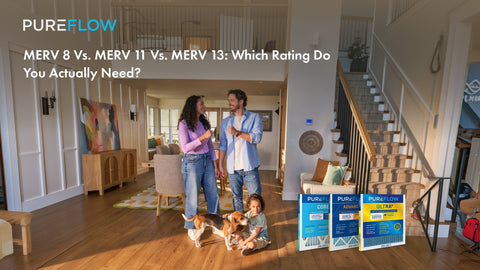
MERV stands for Minimum Efficiency Rating Value, a scale created by the American Society of Heating, Refrigerating, and Air Conditioning Engineers. It measures an HVAC filter’s ability to capture large and small (.3 to 10 microns) airborne particles. The MERV rating on air filters goes from 1 to 16, with a higher number, meaning the filter has a better filtration ability to capture smaller particles such as dust, pollen, and pet dander. Choosing a home air filter with a MERV rating between 8 and 13 is generally recommended. Higher-rated filters can restrict air flow, so you want to choose an air filter that captures particles but still allows your HVAC system to operate efficiently.
Breaking Down the MERV Rating Scale
MERV 1-4: Basic filtration
-
These filters are the most basic and typically most inexpensive option.
-
They only capture large particles, down to 10 microns, such as pollen, dust mites, and carpet fibers, and are not suitable for homes with allergy sufferers.
-
They will need to be changed more often to remain effective.
MERV 5-8: Standard Filtration
-
An okay choice for some homes, these filters capture some smaller particles down to 3-10 microns in size but are not recommended for allergy sufferers.
-
They can capture dust, pollen, dust mites, and mold spores.
MERV 9-12: Residential, Commercial, & Hospital Use
-
A better choice for allergy sufferers and homes with pets.
-
These filters can filter particles down to 1-3 microns in size.
-
They can capture pollen, dust mites, mold spores, dust, bacteria, and pet dander.
MERV 13
-
The best choice for homes with allergy or asthma sufferers.
-
These filters effectively filter particles from 1-0.3 microns in size.
-
They capture pollen, dust, dust mites, mold spores, respiratory droplets, bacteria, pet dander, skin flakes, viruses, cooking and tobacco smoke, and smog with no problem.
MERV 14 and Above
-
These filters are generally not for home use but for hospital and laboratory use.
-
They capture small particles such as bacteria, smoke, and respiratory droplets but will majorly impact airflow in a regular HVAC system.
PUREFLOW® Home Air Filters have a MERV-13 rating, making them the perfect choice to prevent allergens from entering your home this spring and allergy season. Designed to protect your home's air quality and keep your HVAC system running efficiently, our filters feature four layers of advanced filtration technology. The first layer is the high-efficiency MERV-13 layer, which stops more than 90% of contaminants from entering your air. Pollen, dust, and other common allergens don’t stand a chance.
Choosing the right MERV rating for your home air filter is the key to keeping your family healthy this allergy season and pollen, dust, and other allergens out of your home. PUREFLOW® Home Air Filters have a MERV-13 rating and can help keep your home free of irritants, allowing you and your family to enjoy the season without allergy symptoms holding you back. Find your PUREFLOW® Home Air Filter today.