QUICK ANSWER
For most homes, MERV 8 provides dependable everyday filtration for dust and pollen. MERV 11 offers enhanced filtration for homes with pets, seasonal allergies, or higher airborne particle levels. MERV 13 delivers the highest level of filtration available from PUREFLOW® while also helping reduce common household odors with an activated charcoal layer. The best choice depends on your indoor air quality needs and whether your HVAC system is compatible with higher-efficiency filters.
Choosing a furnace filter isn't just about finding the right size - it's also about selecting the right MERV rating. MERV 8, MERV 11, and MERV 13 each provide a different level of filtration, making it important to understand which is best for your home.
The MERV (Minimum Efficiency Reporting Value) rating measures how effectively an air filter captures airborne particles while allowing proper airflow through your HVAC system. In general, the higher the MERV rating, the smaller the particles the filter is designed to capture.
MERV 8, MERV 11, and MERV 13 all help improve indoor air quality, but each is designed for different filtration needs. Choosing the right MERV rating can help reduce common airborne contaminants like dust, pollen, pet dander, and mold spores while maintaining the airflow your HVAC system needs to operate efficiently. For homeowners looking for the highest level of filtration, PUREFLOW® MERV 13 filters also feature an activated charcoal layer that helps reduce common household odors.
Understanding the differences between these MERV ratings will help you choose a furnace filter that best matches your home's indoor air quality needs while ensuring compatibility with your HVAC system.
What Is a MERV Rating?
MERV stands for Minimum Efficiency Reporting Value, the industry-standard rating developed by ASHRAE (American Society of Heating, Refrigerating and Air-Conditioning Engineers) to measure how effectively an HVAC air filter captures airborne particles. Simply put, the higher the MERV rating, the smaller the particles the filter is designed to capture.
For residential HVAC systems, MERV ratings typically range from 1 to 16, with higher ratings providing more efficient filtration of finer airborne contaminants such as pollen, pet dander, mold spores, and smoke-sized particles. Choosing the right MERV rating helps balance cleaner indoor air with the airflow your HVAC system is designed to maintain.
MERV ratings can generally be grouped into the following categories:
- MERV 1–4: Basic filtration designed to capture larger particles like lint, carpet fibers, and household dust.
- MERV 5–8: Standard residential filtration that helps capture common airborne particles such as dust, pollen, mold spores, and lint.
- MERV 9–12: Enhanced filtration that captures finer particles, making it a good choice for homes with pets, seasonal allergies, or increased indoor air quality needs.
- MERV 13–16: High-efficiency filtration that captures much finer airborne particles, including smoke-sized particles, bacteria, and other microscopic contaminants. Some filters in this category also include activated charcoal to help reduce common household odors.
- MERV 17–20: Specialized filtration designed for hospitals, laboratories, and cleanrooms rather than typical residential HVAC systems.
A Quick Guide to MERV Ratings
Here's a simple MERV rating chart to show how the scale breaks down and what each range is generally used for.
| MERV Range | Filtration Level | Particle Size | Common Contaminants | Typical Applications |
|---|---|---|---|---|
| 1–4 |
Basic
|
>10 microns
|
Lint, carpet fibers, larger dust particles
|
Basic residential filtration
|
| 5-8 |
Standard
|
3–10 microns
|
Dust, pollen, dust mites, mold spores
|
Residential and commercial HVAC systems
|
| 9-12 |
Enhanced
|
1–3 microns
|
Pet dander, finer dust, mold spores, and other smaller airborne particles
|
Residential and commercial HVAC systems
|
| 13-16 |
High-Efficiency
|
0.3–1 micron
|
Antimicrobial technology
|
Homes with higher indoor air quality needs, healthcare facilities, and laboratories
|
| 17-20 |
Ultra High-Efficiency
|
<0.3 micron
|
Extremely small airborne particles used in specialized filtration environments
|
Cleanrooms and specialized environments
|
For a more detailed explanation of how MERV ratings work and what each rating means, read our guide, Why MERV Rating Is Important.
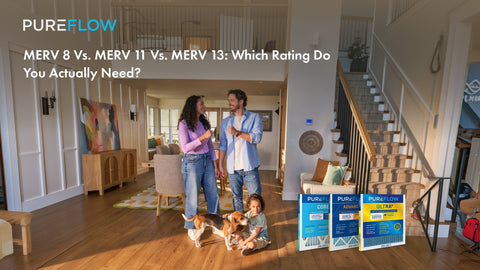
PUREFLOW® home furnace filters are available in MERV 8, MERV 11, and MERV 13 to help meet a variety of residential air filtration needs. Each filter is designed to provide a different balance between filtration efficiency and HVAC airflow, making it easier to choose the option that best fits your home's needs.
Quick Tip: Before choosing a higher MERV-rated filter, check your HVAC system owner's manual for the recommended filter rating. Using a filter with a higher MERV rating than your system is designed to accommodate may reduce airflow and affect overall HVAC performance.
Choose Your PUREFLOW® Home Filtration Level
| Feature | MERV 8 (Core) | MERV 11 (Advanced) | MERV 13 (Ultra+) |
|---|---|---|---|
| Filtration Level |
Standard Filtration
|
Enhanced Filtration
|
High-Efficiency Filtration
|
| Helps Capture |
Common household particles such as dust, pollen, and pet dander
|
Smaller airborne particles, including fine dust, pet dander, mold spores, and other common allergens.
|
Finer airborne particles, including smoke, allergens, and other microscopic particles.
|
| Recommended For |
Everyday residential use and routine dust and pollen control
|
Homes with pets or seasonal allergy concerns
|
Households with higher indoor air quality needs.
|
| Airflow Performance |
Designed to support consistent HVAC airflow
|
Designed to balance enhanced filtration with consistent HVAC airflow
|
Designed to provide high-efficiency filtration while supporting airflow in compatible HVAC systems
|
| Activated Charcoal Layer |
No
|
No
|
Yes
|
| Helps Reduce Household Odors |
No
|
No
|
Yes
Helps reduce common household odors, including cooking and pet odors.
|
BY THE NUMBERS
PUREFLOW® Ultra+ MERV 13 filters are designed to capture a high percentage of fine airborne particles within the MERV 13 particle-size range, helping reduce dust, pollen, pet dander, mold spores, smoke-sized particles, and other airborne contaminants as air circulates through your HVAC system. An integrated activated charcoal layer also helps reduce common household odors, providing cleaner, fresher indoor air.
Which MERV Rating Should You Choose?
The right MERV rating depends on your household's indoor air quality needs and your HVAC system's recommended filter rating. The following guidelines can help you choose the option that best fits your home.
- Everyday households and smaller living spaces: MERV 8 (Core) is designed to provide everyday filtration for common airborne particles such as dust and pollen while helping maintain proper HVAC airflow.
- Homes with pets or seasonal allergy concerns: MERV 11 (Advanced) provides enhanced filtration to help capture finer airborne particles, including pet dander and finer dust.
- Homes seeking higher indoor air quality: MERV 13 (Ultra+) offers the highest level of residential filtration in the PUREFLOW® lineup and is designed to capture finer airborne particles.
- Homes looking for odor reduction: MERV 13 (Ultra+) includes an activated charcoal layer that helps reduce common household odors, including cooking and pet odors.
- Urban homes or areas with higher airborne pollution: MERV 13 (Ultra+) is designed for households looking to capture finer airborne particles.
PUREFLOW® Home Furnace Filters are available in Core (MERV 8), Advanced (MERV 11), and Ultra+ (MERV 13), making it easy to choose the filtration level that best fits your home and HVAC system.
Breathe Easier With the Right Filter
Choosing between MERV 8, MERV 11, and MERV 13 doesn't have to be complicated once you know what each rating actually does. Whether you're looking for dependable everyday filtration, enhanced filtration for pets and allergies, or the highest level of residential filtration with odor reduction, PUREFLOW® offers an option to match your needs.
To find the right MERV rating and filter size for your HVAC system, explore PUREFLOW®'s complete lineup of home furnace air filters and choose the option that's right for your home.
Frequently Asked Questions
Q1. Are higher MERV ratings always better for home air quality?
Not necessarily. A higher MERV rating captures smaller airborne particles, but it may also create greater resistance to airflow. The best choice is the highest MERV rating recommended for your HVAC system while meeting your indoor air quality needs.
Q2. Do MERV filters affect HVAC system efficiency?
Higher MERV filters use denser filtration media, which can increase airflow resistance. Choosing a filter that matches your HVAC system's recommended MERV rating and replacing it on the recommended schedule helps support efficient HVAC performance.
Q3. What MERV rating is best for reducing dust in a home?
MERV 8 is designed to help capture common household dust, pollen, and other larger airborne particles for everyday residential use. For enhanced filtration of finer particles, MERV 11 is a strong choice for many homes.
Q4. Should I choose MERV 11 or MERV 13 if I already have allergies?
Many households looking to reduce common airborne allergens choose either MERV 11 or MERV 13. MERV 13 captures finer airborne particles, but always verify that your HVAC system supports the selected MERV rating.
Q5. Where can I buy high-quality MERV filters online?
PUREFLOW® offers MERV 8, MERV 11, and MERV 13 home furnace air filters in a wide range of sizes, making it easy to find the right fit for your HVAC system.
Q6. Does a higher MERV rating restrict airflow?
Generally, yes. Higher MERV ratings are designed to capture smaller airborne particles, which can create greater airflow resistance because of denser filter media.
Q7. How often should you replace your furnace filter?
Most home furnace filters should be replaced every 1 to 3 months, depending on household conditions and HVAC usage. Homes with pets or higher dust levels may require more frequent replacement.